Many people, especially creative types (which is really all of us!) feel they have a book inside? So how do you get published?
I suggest that you begin by going down to your local Half Price Books (or the equivalent) and see if you can find an old copy of one of the annual Writer’s Market books. You don’t need the most recent year. For example, you could buy the 2006 Writer’s Market. It’s about two inches thick. In the beginning pages of this annually published book you’ll find instructions for how to write a query letter and how to format a manuscript. Following some preliminary articles about writing, the book consists primarily of listings of publishers and their requirements. It’s a great resource.
When I teach my grad-level writing students, I usually make it a point to tell anyone who wants to write a book that the best place to begin is by writing magazine articles on the same topic as the proposed book. (Writer’s Market also tells how to do this.) Going to a publisher with a book manuscript without ever writing magazine articles is like going to a church of 3,000 fresh out of seminary and applying for the job of senior pastor. Sometimes it’ll happen, but usually publishers want to see a track record. They need to know you are used to "being edited," that you can meet deadlines, that you have begun to develop a following on your subject, and that you know terms. (For example, SASE is a self-addressed stamped envelope and not some society to which you must belong, as one student thought.)
Once you’ve published several articles, put together a book proposal. Outline what you plan to include in each chapter, along with an analysis of "what’s on the market" (see below). Send the proposal (not manuscript) with copies of your articles to a publisher. If the editorial team likes your concept, the proposal will next go to the marketing department. The people in this department are looking for a couple of things. First of all, most books sell fewer than 5,000 copies. And the publisher wants to stay in business, so you need to convince the team that you can sell enough books to at least break even. You as the author are their best source of sales contacts. So they will want to see—in addition to your manuscript—some marketing information. Here’s what that involves:
1) Do a search of books related to your topic. Write up a page explaining what you found and how your book differs from every other book out there.
2) Make a list of the places where you’ve spoken in the last year. The publisher will assume that if you have a book, in the future when you speak, you will have opportunities to sell.
3) Write a list of all the key people who could endorse the book in a variety of venues (someone in your denomination, someone who has published a book, the president of a key organization).
4) Gather a list of all the organizations to which you belong. Include alumni associations.
5) List publications where you have published articles on the topic of your book to establish that you are becoming a known source on this subject. One advantage to writing for periodicals is a broader base for reaching people with your message. As I said, the average book does not make it past the 5,000 sales mark. Yet the average magazine has a distribution of more than 40,000 readers. So you will reach a much wider audience with your message by writing an article. Can you write a monthly column for the local newspaper?
The book publisher’s marketing department has a lot of say in the final decision, so the proposal's marketing section is a key element of your manuscript. Publishers operate on a narrow profit margin, so it is vital to the ongoing publishing industry that each time a publisher offers a contract for a book, the company can at least break even.
Consider other vehicles for publishing, too. Self-publishing is becoming a big market. If that interests you, go to the public library and get some past issues of Writer’s Digest magazine. Look up what they have to say on the topic. An advantage there is that via Internet you can sell to readers in Britain and Australia and Kenya and South Africa, where people speak English. (Most U.S. publishers don’t have reps in those places.)Self-publishing used to be called "vanity" publishing and it was looked down on, but now that so many movies are self-produced and called "indies," the stigma is disappearing. One advantage with these last two options is that you can keep a much greater percentage of the profits. For example, on a good contract, right now I make about 12 to 14 percent of retail sales. With self-publishing you keep 100 percent after you’ve paid for production costs. Even though you may not write for the money, greater income means you can re-invest what you’ve made to pay for the costs of producing a second book, if you want to keep writing.
Thursday, August 28, 2008


Monday, August 25, 2008
MoPo at DroolontheFrog Blog
 After spending a great deal of time in a certain field, you tend to develop a keen eye for things that others don't even notice. As the result of studying art, design, and illustration for several years, I've developed an eye for the small print. Mostly in magazines. Any time there's a photo or illustration, I look for the teeny tiny type that gives the name of the photographer or illustrator who created it. I'm a regular reader of WIRED magazine and am thrilled at their high quality of illustrators and photographers and their interest in hi-tech art. Besides marking interesting web sites and memorable quotes as I read, I'll also highlight any photographers or illustrators so I can find their on-line portfolios.
Every Monday on my DroolontheFrog blog there will be a featured portfolio (MoPo or Monday Portfolio) of a current artist, illustrator, and/or designer I've found.
Today's featured artist is Jennifer Maestre. You can also check out the WIRED blurb here.
Jennifer does some amazing sculptures with pencils. That's right, folks, pencils. You have to see it to believe it. I love the creative take she has on such an everyday object.
(I have a personal rule that I will include at least one picture with my posts, but, since these are currently working artists and I value their copyright, I will not be including pictures of their work. I will, however, provide direct links.)
Thursday, August 21, 2008
Perfection Paralysis
From Art And Fear: Observations on the Perils (and Rewards) of Artmaking, David Bayles and Ted Orland
The ceramics teacher announced on opening day that he was dividing the class into two groups. All those on the left side of the studio, he said, would be graded solely on the quantity of the work they produced, all those on the right solely on its quality. His procedure was simple: on the final day of class he would bring in his bathroom scales and weigh the work of the “quantity” group: 50 lbs. of pots rates an “A,” 40 lbs. a “B.” and so on. Those being graded on “quality,” however, needed to produce only one pot- albeit a perfect one- to get an “A.” Well, came grading time and a curious fact emerged: the works of highest quality were all produced by the group being graded for quantity. It seems that while the “quantity” group was busy churning out piles of work- and learning from their mistakes- the “quality” group had sat theorizing about perfection and in the end had little more to show for their efforts than grandiose theories and a pile of dead clay… To require perfection is to invite paralysis.
Sunday, August 17, 2008
Frederick Hart (1944-1999)

A sculptor I greatly admire is Frederick Hart. He is probably best known for my favorite of his works, the "Ex Nihilo" creation above the west entrance to The Washington National Cathedral.
Another of his wonderful works is "The Three Soldiers," near Washington's Viet Nam Memorial. Of it Hart wrote, "I see the [Viet Nam Memorial] wall as a kind of ocean, a sea of sacrifice that is overwhelming and nearly incomprehensible in the sweep of names. I place these figures upon th e shore of that sea, gazing upon it, standing vigil before it, reflecting the human face of it, the human heart...The portrayal of the figures is consistent with history. They wear the uniform and carry the equipment of war; they are young. The contrast between the innocence of their youth and the weapons of war underscores the poignancy of their sacrifice. There is about them the physical contact and sense of unity that bespeaks the bonds of love and sacrifice that is the nature of men at war. And yet they are each alone. Their strength and their vulnerability are both evident. Their true heroism lies in these bonds of loyalty in the face of their aloneness and their vulnerability."
You can access the Hart web site by clinking on the link on his name above. Spend some time enjoying, reading quotes, admiring his work. Hart professed a conversion to Christianity, a decision he came to while working on the Cathedral. Sometimes art changes its creator... May that be true of us.
 e shore of that sea, gazing upon it, standing vigil before it, reflecting the human face of it, the human heart...The portrayal of the figures is consistent with history. They wear the uniform and carry the equipment of war; they are young. The contrast between the innocence of their youth and the weapons of war underscores the poignancy of their sacrifice. There is about them the physical contact and sense of unity that bespeaks the bonds of love and sacrifice that is the nature of men at war. And yet they are each alone. Their strength and their vulnerability are both evident. Their true heroism lies in these bonds of loyalty in the face of their aloneness and their vulnerability."
You can access the Hart web site by clinking on the link on his name above. Spend some time enjoying, reading quotes, admiring his work. Hart professed a conversion to Christianity, a decision he came to while working on the Cathedral. Sometimes art changes its creator... May that be true of us.
Monday, August 11, 2008
Made For More

Clearly, this is made for more.
So obviously wanting.
Blatantly vacant.
Open and receptive.
Ready to be filled- but with what?
It's beyond me what that something should be.
I never envisioned this would stump me.
The organic nature of creation being what it is, however, I'm caught without an answer.
Weeks at a time, I felt like banging my head against the wall or flinging it in the trash.
"Can't I just be done with it?! This is becoming painful."
Once or twice, I almost painted over it. A blank canvas would be relief.
At times it makes me want to scream.
Some days it's more like weeping.
Other days I live in longing.
Dissatisfied.
Gracious friends, though, saw potential
Turned my criticisms on their heads.
Where I saw desolation, they saw invitation.
Redemption.
"Fill me. Mold me. Use me." It said to them.
Well, I never heard it say that. Well, I just never did.
(Was it because I wasn't really listening? Was even interested in listening?)
Had I decided it was hopeless? Dismissed it as junked with nary a thought toward completeness?
And now, of course, I wonder what You might see when You look at these holes.
Clearly we were made for more.

Thursday, August 07, 2008
Hot off the Press

If you’re like me, you already own more books than you can possibly read before A.D. 2020. Still, sometimes you find a new one that calls you to move some stuff to the long-term reading list because it demands attention now.
And it looks like we’ll need to make room on the nightstand for Andy Crouch’s work, Culture Making.
In it he “unleashes a stirring manifesto calling Christians to be culture makers. For too long Christians have had an insufficient view of culture and have waged misguided culture wars. But we must reclaim the cultural mandate to be the creative cultivators that God designed us to be.”
Here are some swanky endorsements from people I respect:
Lauren F. Winner, assistant professor of Christian spirituality, Duke Divinity School, and author of Girl Meets God
Lauren F. Winner, assistant professor of Christian spirituality, Duke Divinity School, and author of Girl Meets God
"Are Christians to be countercultural? Or protect ourselves from 'the culture'? Or be 'in' culture but not 'of' it? In this bracing, super-smart book, Andy Crouch changes the terms of the conversation, calling Christians to make culture. I am hard-pressed to think of something that twenty-first-century American Christians need to read more."
Phyllis Tickle, compiler of The Divine Hours and former religion editor, Publishers Weekly
"In this graceful, articulate volume Crouch challenges Christian common wisdom about creation and challenges as well our traditional understandings about the Revelation to John and how it articulates with the rest of Holy Writ. As refreshing as it is smart, Culture Making is a significant addition to contemporary Christian thought."
David Neff, editor-in-chief and vice president, Christianity Today Media Group
"In Culture Making, Andy Crouch has given us a vision for creativity that is not reserved for the practitioners of high art, but that reveals the dignity of the most ordinary sorts of cultural creation. It is a transformative vision that inspires to action and--in the face of the almost inevitable failures--perseverance. In the end, cultural creativity is not a gift we own, exercise and grow anxious over, but one that we receive and nurture--and through which we come to know grace."
Crouch (M.Div., Boston University School of Theology) is editorial director of the Christian Vision Project at Christianity Today International. He served as executive producer for the documentary films “Where Faith and Culture Meet” and “Round Trip.” He also sits on the editorial board for Books & Culture (to which I subscribe) and has been a columnist for Christianity Today (also on my subscription list). For ten years he served as a campus minister with InterVarsity at Harvard. He’s also a classically trained musician who draws on pop, folk, rock, jazz and gospel.
Monday, August 04, 2008
Prayer: Fact or Fiction
 The most recent SoulPerSuit was a study of Colossians using Sandra Glahn's book Cappuccino with Colossians. The one thing that the group agreed on was that this letter from Paul was a very tough to study. It isn't a peanut butter & jelly sandwich kind of book but more like a Toulouse Cassoulet with a list of ingredients as long as your arm taking days to make.
About half way through the study I stalled. Prayer is not a major or even minor theme in Colossians but this is the topic that shut me down. The times prayer is mentioned (from my quick review of the book), it's not to exhort or instruct but to encourage (Colossians 1: 3-4, 9, 12; 4:12).
The reason I stalled is probably because prayer had been a slow stew in the back of my mind for quite a while. It was even difficult to admit to the group, near the end of the study, that I was struggling with prayer - prayer in all its basic and not so basic aspects, the validity and effectiveness of it. I couldn't imagine starting a conversation with, "I don't think I believe in prayer" without getting, "Are you kidding me?" in return.
When I finally got brave enough to think about what my struggles were with prayer, I was able to nail down where it was at. I don't have a problem with prayer as worship, praise, mediation, or contemplation. Where I struggle is with the requests - asking God to do something.
I've heard a wide range of things asked of God in prayer: to "open a door" or "give direction", to heal someone sick or with cancer, to come through with needed funds, or even to raise the dead. But do these prayers really have an impact? My struggle is this: if I don't ask God to heal my mother-in-law of cancer, will He not do it? Is my prayer necessary for that healing? I don't believe it is. So why do we make these prayers to ask for healing? Doesn't God have a plan? Isn't He working all things together for good? Then what role does my prayer play?
Now I know simply saying this might cause some of you to drop to your knees with wailing and gnashing of teeth, praying for my doubt but I'm not doubting prayer; I'm questioning its use. I believe I'm experiencing a healthy journey into the character of God and the practice of prayer. I mean, we've all got questions about it. Do a search on Amazon for books on prayer and see how many come up. Those books are popular for some reason. Obviously I'm not the first.
No, I don't believe prayer is fiction but maybe some of our uses of it are. That's what I'd like to find out.
I'm going to do my own study on prayer and try to discover what it is really used for, what power it has, and how we are instructed to use it. Don't ask me next week for an answer! I won't have it. I don't know if I'll ever have it but maybe I'll know God a little better. It couldn't leave me anymore confused than those 327,671 books on Amazon.
What are your questions about prayer?
Friday, July 18, 2008
My New Hero
 I have a new hero. His name is Shadrack, and he's the guy in the yellow shirt. He lives on the left side of this structure. The room through the door on the right is where he holds school...for 91 kids (they usually meet under the tree). And after school, he tutors their parents. With zero supplies. No pencils, no paper. Only the dirt to write in. (The same supply Jesus used when he wrote His Complete Works.)
Shadrack is teaching these kids because his spiritual mentors unanimously agreed that he had the right attitude and education for the task. So in obedience to them he went to a place that requires machetes to make a road. A place where the entire community is--or should I say, was--illiterate. A place with no running water and little food. His ultimate goal: to plant a chur ch.
ch.
 ch.
ch. So here's my question. How creative would you have to be to find ways to teach 91 kids at the same time with no supplies? No blackboard. No desks. No chairs. No bus service. (The kids who walk more than four miles show up a little late. Especially in the rainy season.)
Often when we think of creative people we think of visual artists, novelists, sculptors. We think these require the best of our imaginations.
Are you more creative than you thought?
Thursday, July 03, 2008
How is this like church?

Watch this video. It's only four and a half minutes, and really fun.
(If the image is jerky, turning off HD should help. Move your cursor to the right of the video and the blue letters that say "HD is on" will appear. Click it to turn off.)
After watching, tell me in what ways do you think this is like church?
(For more on Matt Harding and his dance check this out.)
Sunday, June 29, 2008
Not Just for the Refrigerator Anymore
In 2005, Korean artist, Yeondoo Jung, did a delicious photographic series called, Wonderland, which interpreted children's drawings.
In this case, it is life which mimics art.
In this case, it is life which mimics art.

Cinderella

The Magician Turned the Whale into a Flower


Miss Sparkle Sprinkles the Magic
Take a look at these other fascinating series by Yeondoo Jung:
Documentary Nostalgia
Bewitched
Wednesday, June 25, 2008
Colossians Resources
 Perhaps you've joined the SPS Yahoo group that's been going through Colossians--and making some cool creations, as you can see. Or maybe you're doing a study on your own. Either way, here are some Colossians resources:
Bible.org has wonderful audio messages, articles, and textual notes on Colossians.
Dr. Tom Constable, a professor at Dallas Seminary, has compiled extensive notes on the Book of Colossians. He makes his notes available online for free. You can access the .pdf file by following this link: Constable notes
Go here for Matthew Henry's complete commentary on Colossians
For online searches of biblical art relating to Colossians, follow this link to biblical art
After the NET Bible notes, my favorite commentary on Colossians is by Kent Hughes.
Tuesday, June 24, 2008
Why do things happen?

On Sunday, I was struggling with the age-old question of "Why?" Why do things happen? I'm a logical person and process things based on what I can know. I become afraid of the things I don't or can't know. I avoid them and only play the games where I know the rules.
The process of merging my logic with faith has been an exercise in accepting that there are things I cannot know. There are many, many things that I will never have the answers to. It reminds me that I am the child and not the Adult. It reminds me that I am the created and not the Creator.
Sunday my logic and faith collided with such force my why question went to a dark place. What if there is no reason why? What if the bad things that happen mean nothing? In a moment of deep darkness, you lose your grip on everything – even hope and purpose.
Much later I recalled a podcast I listened to this year of Rob Bell's Easter sermon. I encourage you to listen to the whole thing (select number 9, March 23, “Boasting Will Abound”, 49:10 minutes), but if you want to get to the why part of it all, skip forward to about minute 34:40. In it he uses a monologue from the movie Elizabeth: The Golden Age where Sir Walter Raleigh is describing to Queen Elizabeth what it's like to sail a vast, unpredictable ocean looking for a land that you've only been told exists. And then Bell says,
Resurrection is the belief that no matter how bad it gets, no matter how dark it is, no matter how long it's been since you haven't seen anything on the horizon, resurrection is the belief that at some point you will see land. You will see land. Others will see land. All of creation will see land. Resurrection is belief that God hasn't given up on this world despite all evidence to the contrary. This world is loved. This world has been rescued and this world will not be abandoned.
You have not been abandoned.
I have not been abandoned.
And, one day, it will all come beautifully into view for everyone.
Monday, June 16, 2008
Rising Numbers- Giveaway Results
Congratulations to Lela, winner of the Prang watercolor pencils.
With the long summer nights in Moscow, you will have plenty of light by which to watercolor. :) E-mail me your snail mail address and I'll ship these off to you ASAP.
Thanks to all of you who participated and made me feel not so alone in my gas-poverty and sweatiness.
With the long summer nights in Moscow, you will have plenty of light by which to watercolor. :) E-mail me your snail mail address and I'll ship these off to you ASAP.
Thanks to all of you who participated and made me feel not so alone in my gas-poverty and sweatiness.
Saturday, June 14, 2008
For Your Reading List

If you're into faith and art, you should know about Rock and Sling. Check it out here.
Monday, June 09, 2008
Rising Numbers- A Free Giveaway
The heat out here in the DC area has been blistering this week! We've had temps in the high 90's all weekend, with a heat index in the 100's. I never thought I would be asking Texas this, but... can we have some of YOUR summer weather?
I saw on the local news today that gas prices are also reaching skyward. In the Washington DC vicinity prices are hovering right around $4.25 a gallon. It's enough to make a body just want to turn off the car, eat out of the pantry stash, and stay and sweat in the "comfort" of their own home.

This week I'm giving away another set of those ever-popular watercolor pencils. (The numbers are rising with these too- but in a way I hope you'll find more pleasurable than summer temperatures and petrol prices.) Last time I gave away a four pack, but I'm upping it to a set of 10 Prang Gallery watercolor pencils and a brush.
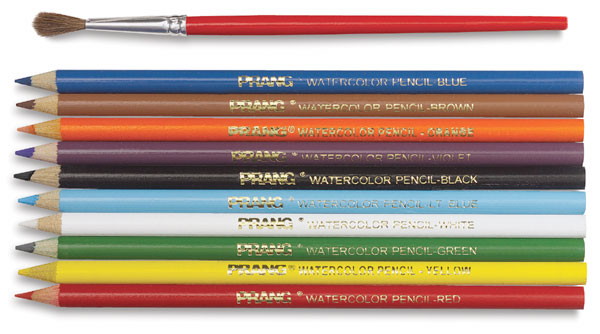
This way, you'll be prepared for the next round of SoulPerSuit. Or at least have something to do with yourself while you're sitting at home, sweating and not driving your car.
Want to enter your name in the drawing? Answer two questions in the comment section to be eligible, I'll draw a name at random:
1) What is today's temperature where you live?
2) What is the price of fuel in your area?
I'll draw and post the winning name next Monday, June 16th.
Stay cool and stay home.
I saw on the local news today that gas prices are also reaching skyward. In the Washington DC vicinity prices are hovering right around $4.25 a gallon. It's enough to make a body just want to turn off the car, eat out of the pantry stash, and stay and sweat in the "comfort" of their own home.
Want to enter your name in the drawing? Answer two questions in the comment section to be eligible, I'll draw a name at random:
1) What is today's temperature where you live?
2) What is the price of fuel in your area?
I'll draw and post the winning name next Monday, June 16th.
Stay cool and stay home.
Thursday, June 05, 2008
Men and Women as Co-Creators

My friends Sue, Kelley, and Henry have recently coauthored a new book that tackles an important subject. It's called Mixed Ministry: Working as Brothers and Sisters in an Oversexed Society. The title says it all. Whether co-writing or partnering to find creative solutions to social problems or running a drama ministry, women and men in Christ's Body need to think of and treat each other as siblings.
You can read an excerpt (pdf) by going here:
Monday, June 02, 2008
LetterJames.com
 AlphaPicture patented a technology called Widescope that allows two pictures to seamlessly fade into each other as if they were one photo to begin with. To promote their technology and their products they created the LetterJames web site. Here, up to 25,000 visitors a day create free pictures with customized text that you can e-mail to friends so they can e-mail two friends, and so on, and so on, ...
For the free feature, click here or look for the E-cards link on the home page. Images created are 72 dpi and about 4"x4" (please respect copyright). You can also test out the feature in the right side bar by typing the text you want and selecting one of the pictures.
They also have a product line for sale but I think it's only setup for the UK. But the free E-cards are cool.
Have fun!

Monday, May 26, 2008
Monday, May 19, 2008
SoulPerSuit Colossians Study
SoulPerSuit is presently hosting a group going through the book of Colossians.
Sandi shared this great clip with me last week and I think it's a great piece to share with the entire group. And the world, at large.
Be amazed by it. Be blessed by it.
Louie Giglio- Laminin (approx. 9 mins.)
Sandi shared this great clip with me last week and I think it's a great piece to share with the entire group. And the world, at large.
Be amazed by it. Be blessed by it.
Louie Giglio- Laminin (approx. 9 mins.)
Thursday, May 15, 2008
Last year I discovered Dante's genius for the first time. So today, I give you some of my favorites:
Foolish is he who hopes our intellect can reach the end of that unending road only one Sustance in three Persons follows.
Purgatorio iii 34-36
He who best discerns the worth of time is most distressed whenever time is lost.
Purgatorio iii 777-78
His choice phrases:
celestial justice
sturdy intellects
filthy effigy of fraud
colored with shame
His gift for humor:
"Perhaps you did not think I was a logician."
And finally, his words that give us new insight into old stories:
"Haste denies all acts their dignity."
In these six words I see a prodigal father running to spend his dignity to buy his child a few more seconds in his arms.
Foolish is he who hopes our intellect can reach the end of that unending road only one Sustance in three Persons follows.
Purgatorio iii 34-36
He who best discerns the worth of time is most distressed whenever time is lost.
Purgatorio iii 777-78
His choice phrases:
celestial justice
sturdy intellects
filthy effigy of fraud
colored with shame
His gift for humor:
"Perhaps you did not think I was a logician."
And finally, his words that give us new insight into old stories:
"Haste denies all acts their dignity."
In these six words I see a prodigal father running to spend his dignity to buy his child a few more seconds in his arms.
Subscribe to:
Comments (Atom)


 Posts
Posts